 Asclepio
Voice: larynx in 3D
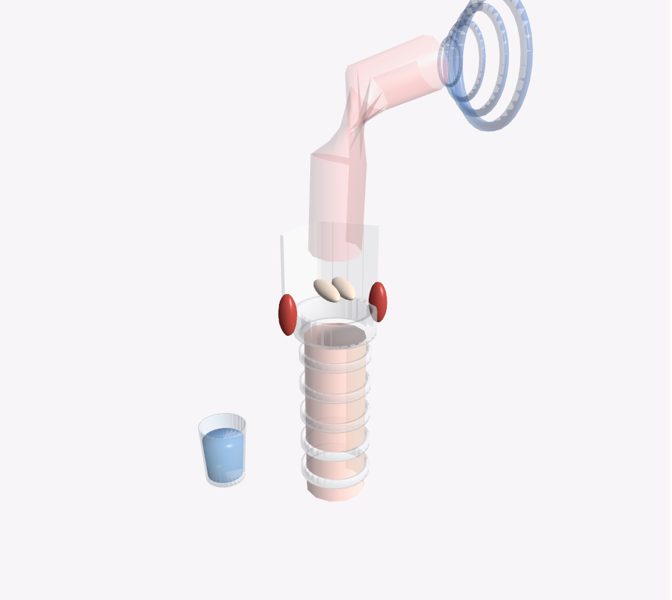
Your voice is made in three steps. First, your lungs work like a bellows that pushes air upward. Next, in the larynx, the vocal cords come together and…
Explained for every age
For kids (7–11)
To talk, your body works as a team: your lungs push air, two folds in your throat vibrate and make a buzz, and your mouth, tongue and lips turn it into words. Put your hand on your neck and say "aaa": you'll feel it vibrate!
For teens (12–16)
Your voice is made in three steps. First, your lungs work like a bellows that pushes air upward. Next, in the larynx, the vocal cords come together and vibrate with that air, creating a basic sound similar to a buzz. Finally, your throat, mouth and nose change that sound, and your tongue, palate, lips and cheeks shape it into vowels and consonants. Your brain coordinates all of this in fractions of a second.
Pre-Med (17+)
Voice production is described by the source-filter model. The source is the larynx: exhaled air sets the adducted vocal folds vibrating and generates pulses with a fundamental frequency (the pitch) and many harmonics. The force of exhalation contributes to loudness, while pitch is adjusted through the length, tension and mass of the folds, controlled by the intrinsic laryngeal muscles, which are innervated by branches of the vagus nerve. The filter is the supraglottic vocal tract (pharynx, oral cavity and nasal cavity): its resonances, the formants, reinforce certain frequencies, and the position of the tongue, lips, jaw and soft palate changes them to produce vowels and consonants.
What you can explore
Vocal foldsGlottisVocal resonance and articulationVoice careLaryngeal muscles
Missions
- Your voice's journey Explorer
- Pitch, timbre and voice changes Discoverer
- Laryngeal physiology and neuroanatomy Pre-Med