 Asclepio
Muscle (histology) in 3D
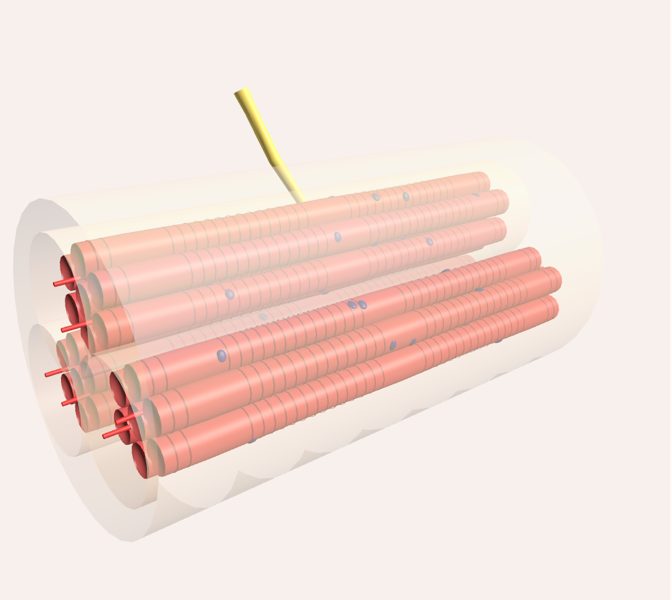
Three connective tissue sheaths: epimysium (wraps the muscle), perimysium (each fascicle) and endomysium (each fiber). The fibers are giant cells with…
Explained for every age
For kids (7–11)
A muscle is a bundle of bundles: the muscle is made of bundles, each bundle of long fibers like threads, and each fiber has stripes. They all shorten at once when the nerve gives the order. Watch how they shorten.
For teens (12–16)
Three connective tissue sheaths: epimysium (wraps the muscle), perimysium (each fascicle) and endomysium (each fiber). The fibers are giant cells with many nuclei at the edge and striations from their sarcomeres. Each fiber has its own capillary and gets its order from a motor nerve at the motor end plate.
Pre-Med (17+)
Muscle fiber: multinucleated syncytium (peripheral nuclei, unlike cardiac muscle), sarcolemma with T tubules at the A–I junction, sarcoplasmic reticulum with terminal cisternae (triad), myofibrils with sarcomeres. Type I (slow, oxidative, red) and type II (fast, glycolytic) fibers. Motor unit; motor end plate with nicotinic acetylcholine receptors. Epimysium, perimysium and endomysium are continuous with the tendon.
What you can explore
EpimysiumPerimysium and fasciclesSkeletal muscle fiberMuscle capillariesMotor nerve and neuromuscular junctionActomyosin
Missions
- Bundles of bundles Explorer
- Three sheaths and a command Discoverer
- Histology and myopathies Pre-Med