 Asclepio
Reflex arc in 3D
A reflex arc is the path nerves follow in a reflex: a receptor detects something, a sensory neuron carries the signal to the spinal cord, and a motor…
Explained for every age
For kids (7–11)
When the doctor gives you a little tap below the knee, your leg kicks all by itself, without you thinking about it! That's a reflex. The signal goes from the knee to the spinal cord and back to the muscle in a fraction of a second.
For teens (12–16)
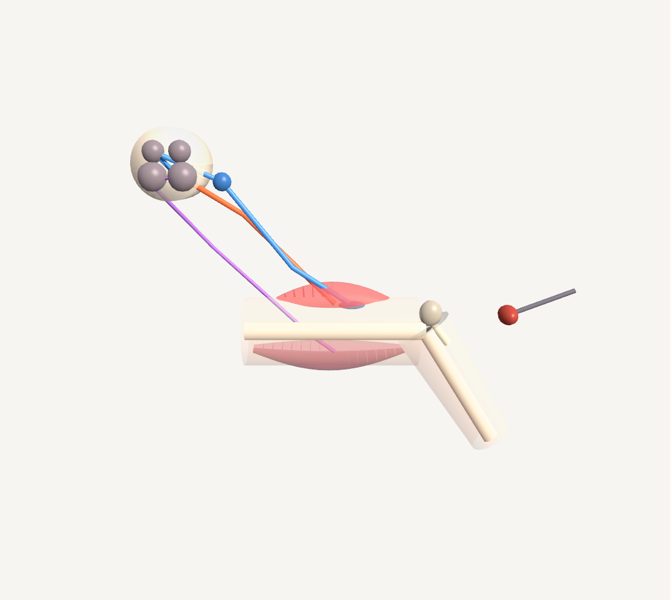
A reflex arc is the path nerves follow in a reflex: a receptor detects something, a sensory neuron carries the signal to the spinal cord, and a motor neuron tells a muscle to respond. Because the signal doesn't have to go to the brain first, the response is very fast; the brain finds out while the reflex is already happening. In the knee-jerk reflex, the tap stretches the quadriceps, the quadriceps contracts, and the leg kicks, while the hamstrings relax.
Pre-Med (17+)
The patellar reflex is a stretch reflex and the classic example of a monosynaptic arc: tapping the patellar tendon below the kneecap stretches the muscle spindles of the quadriceps; afferent fibers reach the spinal cord and synapse directly (glutamatergic) with alpha motor neurons at L3–L4, which contract the quadriceps and extend the knee. At the same time, the afferent input activates inhibitory interneurons that release glycine onto the motor neurons of the antagonist hamstrings (reciprocal inhibition). The latency between stretch and onset of contraction is about 18 ms. It tests segments L2 to L4. It is a proprioceptive reflex that helps maintain posture and balance. The scene is an 8 s diagram; the signal travels as a pulse of light.
What you can explore
Patellar tendon tapMuscle spindleSensory neuronSpinal cord (cross-section)Motor neuronInhibitory interneuronQuadriceps (effector)Hamstrings (inhibited)
Missions
- The reflex kick! Explorer
- The parts of the reflex arc Discoverer
- Stretch reflex and clinical practice Pre-Med