 Asclepio
Diffusion and osmosis in 3D
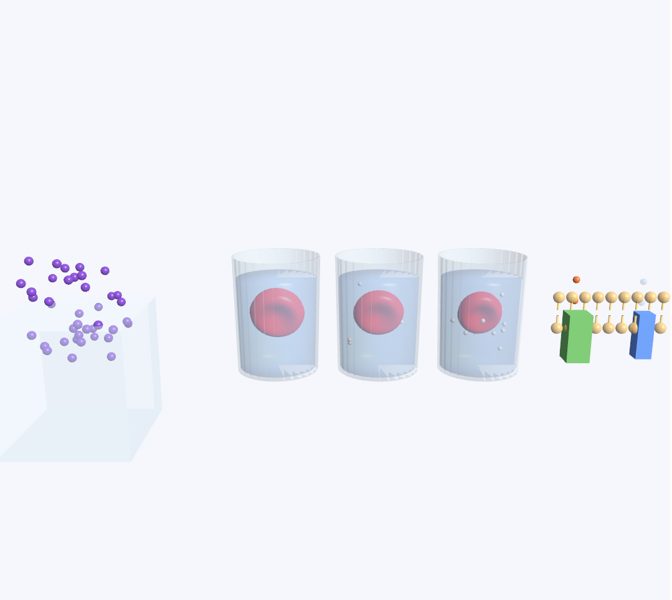
The cell exchanges substances with its surroundings through the plasma membrane. In passive transport no energy is spent: diffusion moves particles from…
Explained for every age
For kids (7–11)
Your cells need good things to come in, like oxygen and sugar, and leftover things to go out. Many things move on their own from where there is a lot to where there is little, like the smell of perfume filling a room. Others need special doors or pumps.
For teens (12–16)
The cell exchanges substances with its surroundings through the plasma membrane. In passive transport no energy is spent: diffusion moves particles from where they are more concentrated to where they are less concentrated, and osmosis is the passage of water through a semipermeable membrane. In active transport the cell spends energy (ATP) to move substances against their gradient, as the sodium-potassium pump does. This explains, for example, gas exchange in the alveoli of the lungs.
Pre-Med (17+)
Membrane transport mechanisms: simple diffusion (gases, small and lipid-soluble molecules), facilitated diffusion through channels and carriers, osmosis (with or without aquaporins), primary active transport (ATPases such as Na⁺/K⁺-ATPase) and secondary active transport (cotransport coupled to the Na⁺ gradient), and bulk transport by endocytosis and exocytosis. The tonicity of the medium determines cell volume; its most direct clinical application is the choice of intravenous solutions. See also the cards "Plasma membrane" and "Pulmonary alveolus".
What you can explore
DiffusionOsmosisTonicity and the red blood cellActive transportPlasma membrane transport
Missions
- Travelers of the cell Explorer
- Diffusion and osmosis in action Discoverer
- Membrane transport and tonicity Pre-Med