 Asclepio
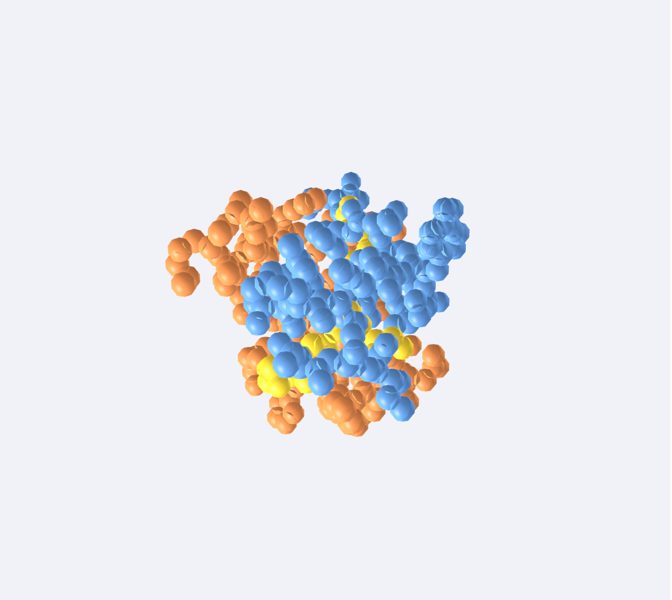
Insulin (real molecule) in 3D
A 51-amino-acid hormone made by the beta cells of the pancreatic islets. It has two chains, A (21 amino acids) and B (30), joined by disulfide bridges…
Explained for every age
For kids (7–11)
Insulin is a teeny-tiny hormone made by the pancreas. When you eat and the sugar in your blood goes up, insulin tells the liver, the muscles and the fat to let that sugar in and store it. Its name comes from the Latin word for “island,” because it is made in little clusters of cells in the pancreas called islets. This is its real shape, atom by atom.
For teens (12–16)
A 51-amino-acid hormone made by the beta cells of the pancreatic islets. It has two chains, A (21 amino acids) and B (30), joined by disulfide bridges between cysteines. When blood glucose rises, the beta cells release it; insulin makes the liver, muscles and fat tissue take up glucose and store it as glycogen or fat, which lowers blood sugar. What you see is human insulin made by genetic engineering and measured with X-rays (PDB 3I40).
Pre-Med (17+)
A 5808 Da heterodimer (C₂₅₇H₃₈₃N₆₅O₇₇S₆): a 21-residue A chain with two antiparallel helices (A1–A8 and A12–A19) and a 30-residue B chain with a central α-helix (B9–B19). Two interchain disulfide bridges (A7–B7, A20–B19) and one intrachain bridge (A6–A11). It is synthesized as a 110-amino-acid preproinsulin; in the granules, prohormone convertases 1/3 and 2 remove the C-peptide and carboxypeptidase E trims the ends. It is stored as a hexamer with Zn²⁺ coordinated by His B10; the active form is the monomer, which binds the α subunits of the insulin receptor and activates the tyrosine kinase of the β subunits (IRS-1, PI3K, GLUT4 insertion in muscle and adipose tissue). Structure 3I40: recombinant human insulin at 1.85 Å (Timofeev et al., 2010).
What you can explore
Insulin A chainInsulin B chainCysteines and disulfide bonds
Missions
- The sugar hormone Explorer
- Two chains and three bridges Discoverer
- From proinsulin to hexamer Pre-Med