 Asclepio
Immune response in 3D
The immune system has two big strategies. Innate immunity is with you from birth: barriers such as the skin and mucous membranes, and cells such as…
Explained for every age
For kids (7–11)
When a germ gets in through a cut, your body puts together a defence team. First come the fast defenders, who attack any intruder. Then come the specialists, who make weapons tailor-made for that germ and remember it for next time.
For teens (12–16)
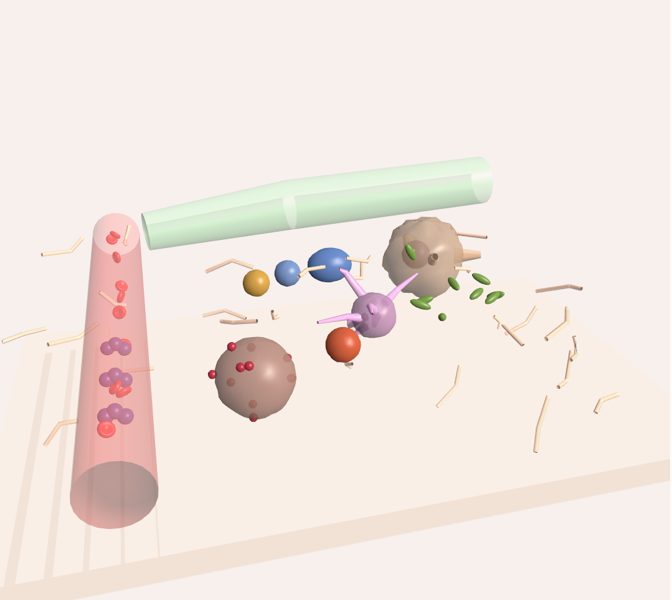
The immune system has two big strategies. Innate immunity is with you from birth: barriers such as the skin and mucous membranes, and cells such as neutrophils and macrophages that react the same way to many germs. Adaptive immunity, with B and T lymphocytes, recognizes each particular germ, produces antibodies and leaves a memory. This scene shows both responses in an infected tissue in 30 seconds.
Pre-Med (17+)
The innate response uses germline-encoded receptors that detect patterns shared by microbes; it recruits cells with cytokines, activates complement and initiates inflammation. The adaptive response acquires specific receptors during life (through V(D)J recombination) and is divided into humoral (antibodies from plasma cells) and cell-mediated (T lymphocytes) immunity. Dendritic cells link the two: they carry antigen to the lymph node and present it to T cells. After the primary response, memory B and T cells remain and mount a faster, stronger secondary response. Scene simplification: B- and T-cell activation is shown in the tissue, but it takes place in secondary lymphoid organs (lymph nodes, spleen).
What you can explore
InterstitiumInflamed capillaryLymphatic capillaryInvading bacteriaNeutrophil diapedesisMacrophageDendritic cellB lymphocytePlasma cellHelper T cellCytotoxic T cellVirus-infected cellAntibody (immunoglobulin)
Missions
- The defence team Explorer
- Innate and adaptive Discoverer
- From diapedesis to apoptosis Pre-Med