 Asclepio
Emotions and sleep in 3D
Emotions, motivation and sleep depend on networks of neurons that connect deep areas of the brain with its front part. The amygdala detects what might be…
Explained for every age
For kids (7–11)
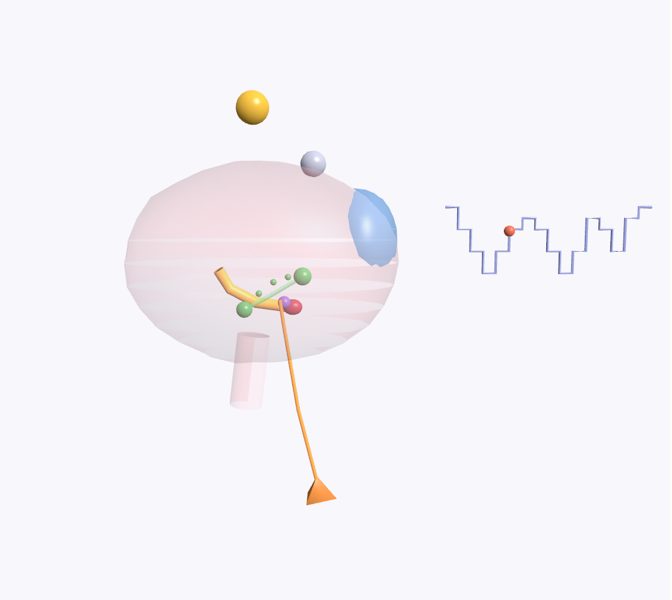
Your brain doesn't just think: it also feels. It has an alarm that warns you of danger, a captain that helps you plan and calm down, a system that makes you want to repeat what you enjoy, a clock that knows when it's night, and a "ready for action" mode. They all work together!
For teens (12–16)
Emotions, motivation and sleep depend on networks of neurons that connect deep areas of the brain with its front part. The amygdala detects what might be dangerous; the prefrontal cortex helps us plan and put the brakes on impulses; the reward system, with dopamine, drives us to seek what is good for us; the suprachiasmatic nucleus, in the hypothalamus, sets the rhythm of day and night; and the stress system prepares the body for challenges. Feeling fear, anger, joy or sadness is normal: emotions give us useful information.
Pre-Med (17+)
The scene brings together limbic circuits and their connections: the amygdala (emotional processing, fear conditioning and modulation of memory consolidation), the prefrontal cortex (executive functions and goal-directed control of behavior), the mesolimbic dopamine pathway (ventral tegmental area → nucleus accumbens: incentive salience and reinforcement learning), the suprachiasmatic nucleus (circadian pacemaker that regulates melatonin) and the stress response (sympatho-adrenomedullary system and hypothalamic-pituitary-adrenal axis). The NREM-REM cycle completes the tour. The hippocampus, hypothalamus and limbic lobe have their own cards in the brain.
What you can explore
AmygdalaPrefrontal cortexReward systemSleep cycleCircadian clockStress response
Missions
- Your brain feels Explorer
- The teenage brain Discoverer
- Circuits of emotion, reward and sleep Pre-Med