 Asclepio
Antibody (real molecule) in 3D
Antibodies are proteins about 10 nanometres in size made by plasma cells. They have four chains: two heavy and two light, joined by chemical bridges. The…
Explained for every age
For kids (7–11)
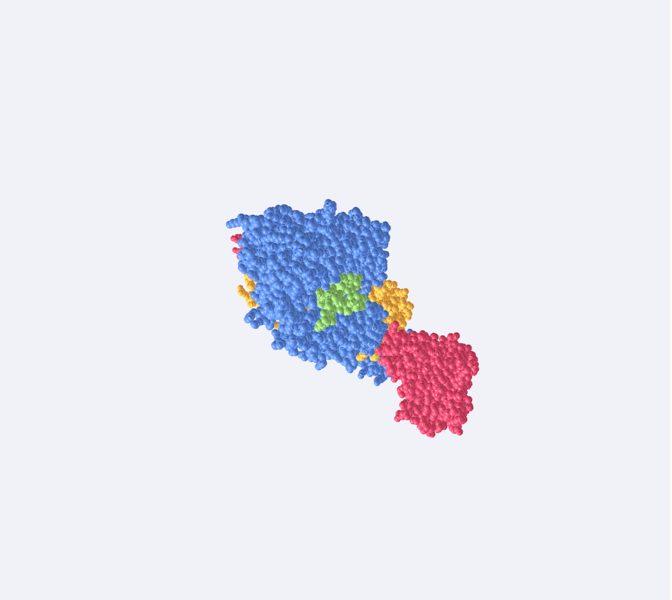
An antibody is a Y-shaped protein. The tips of its arms fit a part of the germ, like a key in its lock, and leave it marked so other defenders can destroy it. This model is a real human antibody, atom by atom; in the immune response scene they are the yellow Ys.
For teens (12–16)
Antibodies are proteins about 10 nanometres in size made by plasma cells. They have four chains: two heavy and two light, joined by chemical bridges. The tips of the Y recognize a specific part of the antigen, and the stem alerts other defences. They neutralize germs and toxins, mark them for phagocytes and activate complement. This is the human antibody b12, which recognizes HIV, determined by X-ray crystallography (PDB 1HZH).
Pre-Med (17+)
A ≈ 150 kDa glycoprotein made of two identical heavy chains and two identical light chains joined by disulfide bonds; each chain is a series of domains of about 110 amino acids. It is divided into two Fab fragments (VH, CH1, VL, CL), which bind antigen, and one Fc fragment, which triggers effector functions, linked by a flexible hinge. Its functions are neutralization, opsonization (Fc receptors on phagocytes), complement activation via C1q and antibody-dependent cell-mediated cytotoxicity. Structure 1HZH is the complete human IgG1 b12 at 2.7 Å (Saphire et al., 2001), which recognizes the CD4-binding site of HIV-1 gp120 with a long, finger-like CDR H3.
What you can explore
Heavy-chain constant regions (Fc)Light-chain constant regionsVariable domains and paratopeFc N-linked glycan
Missions
- A Y that catches germs Explorer
- Anatomy of an antibody Discoverer
- IgG1 b12 at 2.7 Å Pre-Med