 Asclepio
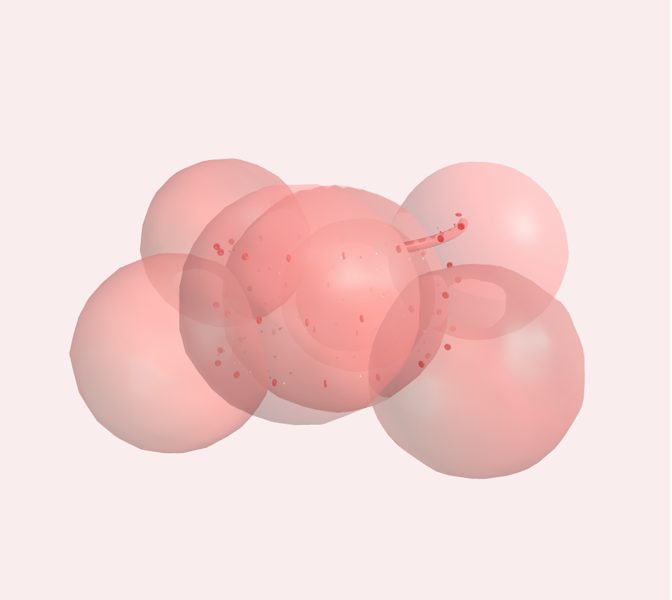
Alveolus in 3D
Air sacs 0.2 to 0.5 mm across, grouped like bunches of grapes at the end of the bronchioles and surrounded by capillaries. Their wall and the capillary…
Explained for every age
For kids (7–11)
Alveoli are tiny air sacs at the end of the bronchi. You have hundreds of millions of them. Their wall is so thin that oxygen passes into the blood and used air comes out.
For teens (12–16)
Air sacs 0.2 to 0.5 mm across, grouped like bunches of grapes at the end of the bronchioles and surrounded by capillaries. Their wall and the capillary wall together measure half a micrometer: through there, oxygen enters the blood and carbon dioxide leaves, by diffusion.
Pre-Med (17+)
Functional unit of gas exchange: about 480 million alveoli on average (with wide variation), surface area 70–80 m². Epithelium of type I pneumocytes (exchange) and type II pneumocytes (surfactant), respiratory membrane 0.2–0.6 µm thick. Diffusion according to Fick's law along the partial pressure gradient: PAO₂ ≈ 100 vs. PvO₂ ≈ 40 mmHg; PACO₂ ≈ 40 vs. PvCO₂ ≈ 46 mmHg. Equilibrium is reached before the end of the capillary transit, which lasts about 0.8 s at rest.
Missions
- The journey of oxygen Explorer
- Diffusion across half a micrometer Discoverer
- Diffusion and the V/Q ratio Pre-Med